Welcome to my Place

Hi everyone,

I hope you will enjoy my place and my photos, I am looking forward to visits from friends, old and new.

Please respect the copyright on my photos. Thank you.

Saturday, 27 August 2016

Sandwich, around the town. Part 1


The original Guildhall which dated from 1359 was situated near to St Peter's Church. The building in the photo above replaced the original Guildhall and was built in 1579. The present building was enlarged twice, once in 1912 and again in 1973. This building was also where the first sandwich as we know it was invented, when in 1762 the 4th Earl of Sandwich was gambling and called for a meal of meat between two slices of bread.


The Guildhall is well worth visiting, guided tours are available but these have to be booked. Above is a wonderful stained window in the  Courtroom to commemorate the visit to the town by Queen Elizabeth 1 in 1572. The Mayor shown in the window is robed in red, usually the Mayor of Sandwich wears a black robe, in memory of a former town Mayor who was killed in a French raid. This tradition dates back to 1457.


The Courtroom in the Guildhall, an exact replica of the courtroom from the earlier Guildhall, a beautiful room housing among other items the Mayors chair dating from 1561, and a very unusual folding Jury Box.


The Market Inn, a very popular place to eat in the town. For many years the Pub was just the Victorian building with the two bay windows on the left of the photo. The other buildings in the centre and to the right of the photo are Medieval and were the 16th Century Tea Rooms. If we were very lucky when we were younger we would be treated to something nice in the restaurant :)

Over the years I have been lucky enough to have been into a small number of these wonderful buildings, I have seen Medieval interiors complete with beams, Priest Holes, wonky meandering staircases, uneven floors and wonderful oak panelled rooms. One house I know of is half Medieval and half Georgian, and is a truly beautiful building, with such a wonderful atmosphere, and there is another house that has a room with walls reputedly painted by monks. I do have some photos of some of these interiors, photos taken with permission of the owners of course, but these photos are of peoples homes and for my use only, so I am unable to share them.


The Old Dutch House, dating from the late 17th Century. At one time this building was known as the 'Shoemaker's House'


Photos of some of the 'jettied' houses in the town, this row has ornate brickwork patterns in between the beam framing.


The Crispin Inn and the Toll Bridge, the Quay is off to the right.


The Old Drum, built in 1450, once a coaching house.


Another row of jettied houses.


A beautiful old house in the town.


The Weavers, Strand Street. Sandwich Library used to be housed in the part of the building next to the white car in the photo, I worked in this tiny part of the building for a year before the Library was moved to its present position in Market Street in 1973. 


The date on the sign of the the Sandwich Weavers building is 1500.


Just to the left of The Sandwich Weavers is Three Kings Yard, complete with the beautiful ruin on the right in the photo. This building is now in the garden of the Chanters House, it is believed to have been a Chapel or 'Chantry' and dates from approximately 1250 when the buildings in Strand Street fronted the river.


The entrance gate (looking from the inside to the street) of St Thomas's Hospital built in 1878. The original hospital was near to the Guildhall and Cattle Market, and was built to house permanently 12 brothers or sisters of the Sandwich Whitefriars Order who probably had monastic buildings throughout the town. The Whitefriars was founded before 1272 and dissolved in 1538.

Sunday, 21 August 2016

Sandwich Kent - the Quay and the River Stour.


The Barbican, built in the 14th Century, and the Toll Bridge.


Looking towards the Toll Bridge from the Quay at sunset.


The Quay from the Toll Bridge, before the flood defences were built.

I have worked in the beautiful town of Sandwich on and off since I was 18, which is when I started as a Library Assistant in the old Sandwich Library, then situated in Strand Street. The tiny building that the Library was housed in was part of the Sandwich Weavers shop, named for the Dutch weavers who came as refugees to the town during the 16th Century, and dating from that time.
A year after I started working in the old Library the 'new' Library opened in 1973, in its present position in Market Street. It is fair to say that I have spent most of my working life in Sandwich, even though I have left and come back to the Library a few times!


Looking up river, in the general direction of Canterbury.


Sandwich is a lovely little town and is 'the most complete Medieval town in England.' Sandwich Haven was a major port and centre for ship building from the 11th Century until the River Stour silted up, leaving the town some distance from the sea. Some of the Royal Naval ships built in the port in the late 1700's sailed in Nelson's fleet. 


Looking down river towards the Toll Bridge.


As the River Stour has been of such great importance to the Town I have made this the subject of this blog. My photos are from the last 6 years or so, just recently the Quay has had extensive flood defence work done, but most of my photos were taken before that.


'The Matthew' visited the town in 2012, this is an exact replica of John Cabot's ship, in which he sailed to America in 1497. The ship is only 80 feet long, weighs 50 tons, and was crewed by just 19 men in very cramped conditions. The voyage took 50 days and the ship is believed to have landed in Newfoundland.
Over the years I have collected a large number of photos of the town, this blog is the first of a series on the town, which will hopefully show just how unique Sandwich really is.


The new flood defence work on the Quay, a lovely place to visit :)


Fisher Gate, looking through to The Quay.


Sunday, 12 June 2016

The Tudor House, Margate Kent


The Tudor House in Margate is something of a surprise, surrounded as it is by modern buildings. I can remember seeing it from the outside when I was a child, and went round it many years ago, when I am pretty sure there was no furniture inside.


Fireplace in the central room, downstairs.


Common food in Tudor times.


This room with the beautiful carved table is to the left of the main door.


I was lucky enough to win tickets to visit the house during the Big Kent Weekend, so my friend and I visited the house one Sunday afternoon. 


This room is more of a formal room, note the beautiful ceiling, added some time later than the original building of the house.


A lovely room :)


As I said before I am pretty sure that the last time I was there there was no furniture, but now there is furniture and other items in the house, which gives the visitor some idea of how the house could have looked in earlier times.


At the top of the narrow, twisting staircase, looking through to the bedrooms.


 A lovely fireplace in one of the bedrooms, with beautiful carving.


The house dates from the 16th Century and is known as a 'Transitional' House, built when the traditional Hall Houses were changing to more modern two story houses. It is thought to have been a high status house, and at one time was part of a larger estate. At some stage of its history the house was divided into three dwellings, and was bought in the 1930's by Thanet District Council to save it from demolition. In the 1950's the house underwent a careful restoration.


The main bedroom, on the wall behind the table is a photo of the house in very sad repair, before restoration.


Sleeping above the fireplace, I think this was probably the warmest spot in the house.

My friend and I thoroughly enjoyed looking round the house, inside and out. After we left there we paid a visit to the amazing Shell Grotto, of which I have written before. We had a lovely afternoon :)


The back of the house.


And round to the front again :)


Sunday, 17 April 2016

Chiddingstone Castle, the Collections


We loved the moustache and beard on this armour, I am sure it must have been very uncomfortable to wear!


Two more amazing sets of armour, designed to scare the wits out of the enemies I think!


Chiddingstone Castle is well known for its amazing collections. Denys Eyre Bower bought the castle in 1955 to show his collections, which in include his Japanese, Ancient Egyptian, Buddhist, Royal Stuart and Jacobite items.


A beautiful inlaid box.


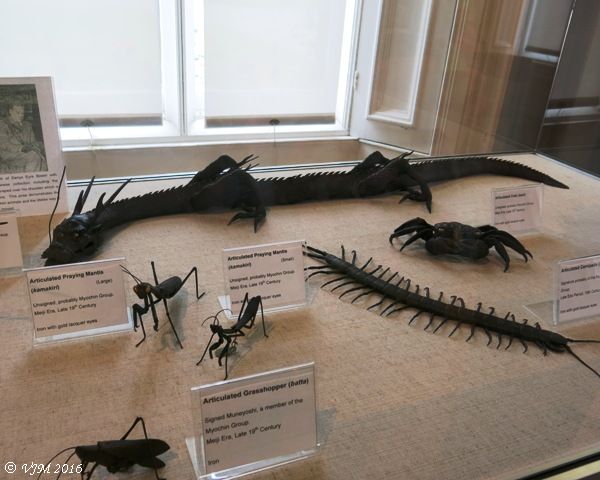
These was amazing, so intricate and very clever.


I love elephants, so had to include this :)


A beautiful lacquer box.

The first room you enter in the Castle houses the Japanese Collection, which consists of some amazing pieces, the suits of armour in particular caught our attention, as did the fantastic Dragon headed sword, inlaid with mother of pearl. 


The Dragon handle, and part of the sword scabbard, inlaid with mother of pearl. The sword is in a large glass cabinet, so I was unable to get a photo of the whole item.


The amazing folding screen in the Library.

The Royal Stuart and Jacobean collection are situated all round the house, below are just some of the amazing paintings we saw.


The children of Charles the First.


Mary, Queen of Scots.


Charles the Second.

The Egyptian Collection has a room to itself, again there are some amazing items, 


A mummy on the landing.


Part of the Egyptian room.


And finally just a few photos of other beautiful items on show


Buddhas :)


One of two beautiful Art Nouveau panels.


A wonderful velvet and silk cape, with bead and lace decoration, in poor condition, but it would have been very beautiful when new.